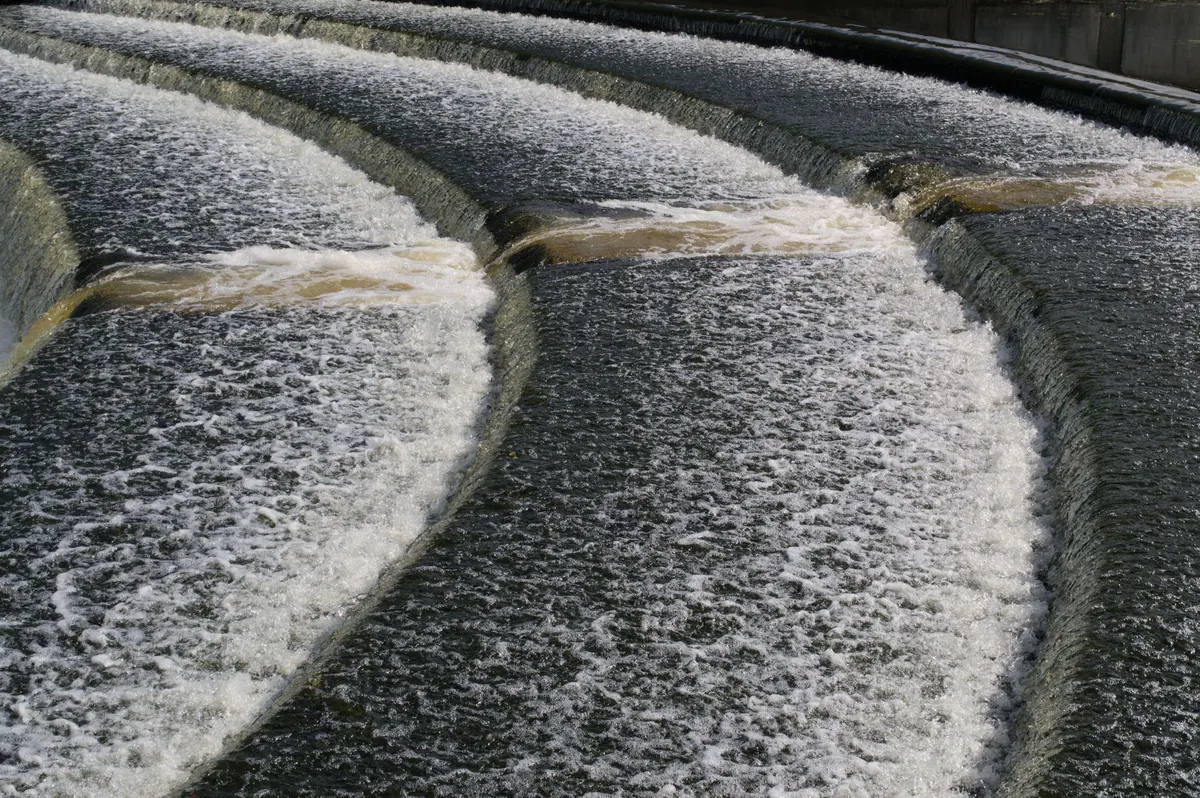
Most paddlers meet their first Avon weir the same way: drifting downstream, enjoying the view, and suddenly noticing that the water ahead has vanished. There is no shortage of them. Between Chippenham and the tidal reach at Bristol, the river drops over old mill weirs, sluices, fish passes and small ledge drops. Some come with tidy portage platforms and canoe rollers. Others mean a steep bank, a stile, and a hundred metres of nettles with a boat on your shoulder. The routine below keeps those crossings uneventful, which is exactly what a portage should be.
Scout from the bank before you commit
On a stretch you don't know, walk it first. Ten minutes on foot above a weir tells you more than any description: where the current slackens near the bank, where the bank is low enough to climb out, and whether the portage path is a real track or a gap in the reeds that gives up after twenty metres. Approach on the inside of a bend if you can, since that's usually where the water is slowest and the bank shallowest.
Look for these things, in this order:
- Where does the flow ease close to the bank? That's your landing spot, and it's usually well upstream of the drop.
- Is there a step, slipway, gravel shelf or just a vertical wall?
- Does the portage path look used — mown grass, a gate, a worn line — or does it disappear into brambles?
- Is there a canoe pass or roller, and is it clear of branches and debris?
- Where is the easiest place to put back in below the weir, clear of the boil and any towback?
Riverside access on the Avon varies from reach to reach. Stick to marked portage routes and public paths where they exist, and if you're unsure whether a path crosses private land, ask the landowner or check with a local canoe club or the navigation authority before you paddle.
Approach early, in control, near the bank
The most common portage mistake isn't a bad carry. It's arriving at the lip of the weir already committed. Make your ferry across to the bank several boat lengths above the drop, while the current is still friendly, and angle upstream as you go so you're not swept sideways into the approach channel.
If you do find yourself too close, don't try to turn in the flow. Point downstream, use your paddle as a brace, and get out at the first safe spot on the bank — even if it's not the spot you planned. A walk back upstream with the boat is annoying. A swim over a weir is not a small thing, and weirs can hold a paddler in a recirculating stopper long enough to be genuinely dangerous. Take the clumsy exit.
If the weir has a canoe pass, treat it as an option rather than a given. They silt up, collect branches and change character with the level. If you haven't inspected it or run it before, portage it.
Getting out at the top
Nose the boat into the eddy until it's parallel with the bank and mostly out of the current, then step out on the upstream side. That way, if the boat slips, it drifts away from the weir rather than towards it — and you're not standing between a moving boat and a drop.
Plant your feet before you lift anything. If the bank is high or slippery, pass the paddle and loose kit up first, then bring the boat out. On a steep, muddy bank it's often easier to pull the boat partly out of the water, unload it there, and carry the gear in stages. Two trips up a slippery bank beat one trip that ends with you on your back.
Unloading and the carry
Heavy gear goes first. Dry bags, barrels, water containers and anything that shifts should come out of the boat before you lift it. An unloaded hull is a different object: lighter, better balanced, and far less likely to twist your back or your wrist. Sponge out any water if the boat has taken some on.
Then work through the portage like this:
- Set the boat on the bank and drain it.
- Take out all loose and heavy kit, and pile it somewhere it won't roll into the river.
- Lift the boat from the middle — cockpit rim, thwart or yoke — and rest it on your shoulder, or slide it onto a trolley if the carry is longer than a couple of hundred metres.
- Carry the kit in a second trip, or ask a partner to shuttle gear while you move the boat.
- Launch the boat below the weir before loading it again, so a slip doesn't send your gear downstream.
With two paddlers, one at the bow and one at the stern works well over rough ground, and a third person can shuttle the bags. Watch for the obvious hazards on the path: wet roots, low branches, stiles, gates that swing back, and anglers who may be quietly fishing a pool you're about to crash through with a plastic boat. A nod, a quiet apology, and a wide berth keep everyone's afternoon pleasant.
Getting back on below the weir
Before you launch, stand at the bottom and look at the water you're about to enter. You want to see where the boil line ends, where the returning water stops pulling back towards the face, and which way the eddy along the bank is moving. Put in well downstream of that reversal, on the bank, not in the middle of the churn.
Hold the boat steady with one hand on the bank, slide in feet first, and push off bow-first so the current takes you forward rather than sideways. Keep the boat straight until you have real control, then ferry out. If the water looks pushier than you expected, sit in the eddy and watch it for a minute. Nothing about a portage requires haste.
Groups, solo paddlers and gear that matters
Wear a buoyancy aid, always, and add a helmet on weirs where there's rock or rubble in the landing area. A throwline on the bank, clipped open and ready, is worth more than a first-aid kit you can't reach. Solo paddlers should be honest about what they can carry alone: if the bank is bad and the boat is heavy, take two trips, or walk the portage first and decide whether to continue at all.
High water changes everything. Portage paths flood, banks undercut, and a weir that was a gentle slope yesterday becomes a keeper today. If the level is up, the honest answer is usually to leave the boat on the roof and walk the bank instead. There's no prize for running something you're not sure about.
The habit that makes it routine
Stop above every weir. Even the one you've portaged twenty times. Take two minutes to look at the water, pick your landing, and check the path — then move. It costs you almost nothing and it removes almost all the risk. The paddlers who make portaging look easy aren't braver than everyone else; they're just in the habit of getting out early, walking slowly, and putting back in somewhere sensible.
Photo: Jakub / Pexels